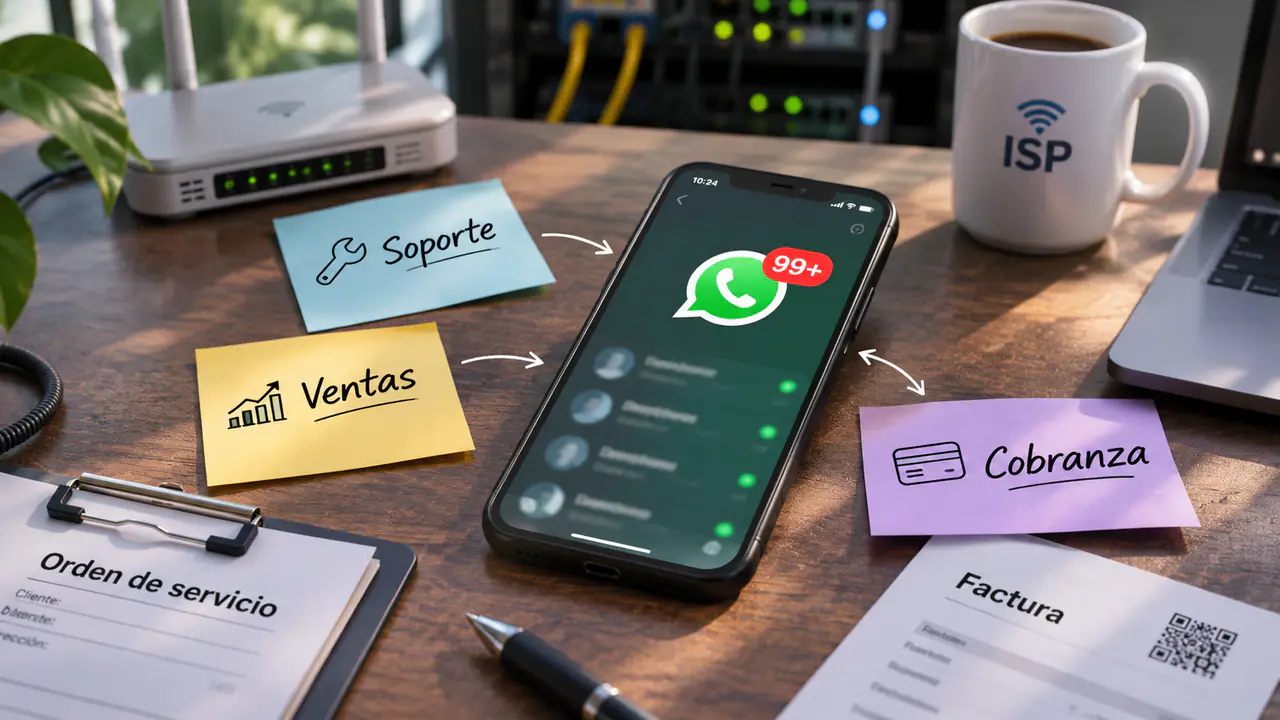
Your customers use it to report an outage, send a proof of payment, ask about a bill, check coverage or simply say: “My internet is down.”
Until September 2026, replying within the 24-hour customer service window didn't generate a charge for service messages.
Since October 1, 2026, that has changed.
Meta started charging for WhatsApp Business Platform service messages according to the recipient's market. Meta defines these as messages used to answer customer-initiated inquiries, whether by a human agent or an AI chatbot. Meta also charges per delivered message, not just per sent message.
The question for ISPs is no longer only: “How much do I use WhatsApp?” Now it is also: “How much of my support operation runs through WhatsApp, and what will it cost me?”
The new pricing logic
From October, the first 1,000 service messages per WhatsApp number each month are free; after that, the rate for the market applies.
The rates announced for October 2026 include:
| Country / market | Service per message |
|---|---|
| Peru | US$0.0300 |
| Argentina | US$0.0260 |
| Chile | US$0.0200 |
| Rest of Latin America | US$0.0113 |
| Mexico | US$0.0085 |
| Brazil | US$0.0068 |
| Colombia | US$0.0008 |
Where does your ISP land?
A much more useful way to look at this change is to start from your subscribers.
As a planning scenario, let's assume half of the subscribers contact the ISP on WhatsApp during the month.
We can also use as a reference what we are seeing at real ISPs, where one conversation can generate roughly 7–8 sent messages.
Assuming 7.5 sent messages per conversation:
| Subscribers | 50% get in touch | Conversations | Approx. messages sent |
|---|---|---|---|
| 3,000 | 1,500 | 1,500 | 11,250 |
| 5,000 | 2,500 | 2,500 | 18,750 |
| 10,000 | 5,000 | 5,000 | 37,500 |
| 25,000 | 12,500 | 12,500 | 93,750 |
| 50,000 | 25,000 | 25,000 | 187,500 |
This doesn't mean every ISP behaves exactly like that.
In fact, our data shows a wide spread:
| Conversations | Messages sent | Messages per conversation |
|---|---|---|
| 2,160 | 15,213 | 7.0 |
| 4,439 | 39,038 | 8.8 |
| 3,531 | 18,303 | 5.2 |
| 7,271 | 55,133 | 7.6 |
| 9,027 | 81,147 | 9.0 |
Example: an ISP with 10,000 subscribers
Let's assume:
- 10,000 subscribers
- 50% contact the ISP during the month
- 5,000 conversations
- 7.5 sent messages per conversation
- 37,500 messages sent
After the first 1,000 free messages, 36,500 messages would be billable. Meta's approximate cost would be:
- PeruUS$1,095
- ArgentinaUS$949
- ChileUS$730
- Rest of Latin AmericaUS$412
- MexicoUS$310
- BrazilUS$248
- ColombiaUS$29
Why does this matter especially to ISPs?
Because WhatsApp isn't just another marketing channel.
For many ISPs it is the main support and customer service channel. Among the ISPs we work with, WhatsApp shows up as the main service channel, and they usually have between 1,500 and 200,000 subscribers.
On top of that, one of the most common operational pains is precisely WhatsApp overload, with conversation volume growing beyond what the human team can handle.
That's why this change can be read in two ways.
The first
“WhatsApp costs more now.”
The second, far more interesting
“I need to design better how I use WhatsApp.”
Because paying for a service message isn't necessarily a problem.
The problem appears when you use an expensive channel for work that could be automated, redirected or solved some other way.
And what does the AI cost?
Here a second variable comes in.
In our current scenarios with Zelty using GPT-4.1-mini, we are seeing approximately:
| Conversations | LLM cost |
|---|---|
| 3,000 | US$75 |
| 5,000 | US$120 |
| 10,000 | US$220 |
That is, roughly between US$0.022 and US$0.025 per conversation in these scenarios.
This lets you look at the cost of a customer service operation as a sum:
The real change
For a small ISP, the new cost can be perfectly manageable.
But for an ISP that handles tens or hundreds of thousands of messages a month, it becomes a line item worth modelling.
And that's where the question changes. It's not only: How much will Meta charge me? It's: What should my ISP's customer service architecture look like in the coming years?
In the next article we look at exactly that: what to do with WhatsApp, what alternatives exist, and when it makes sense to keep it as the main support channel versus options like a web portal, a captive portal, Telegram, Messenger, Instagram or AI automation.
Share this article