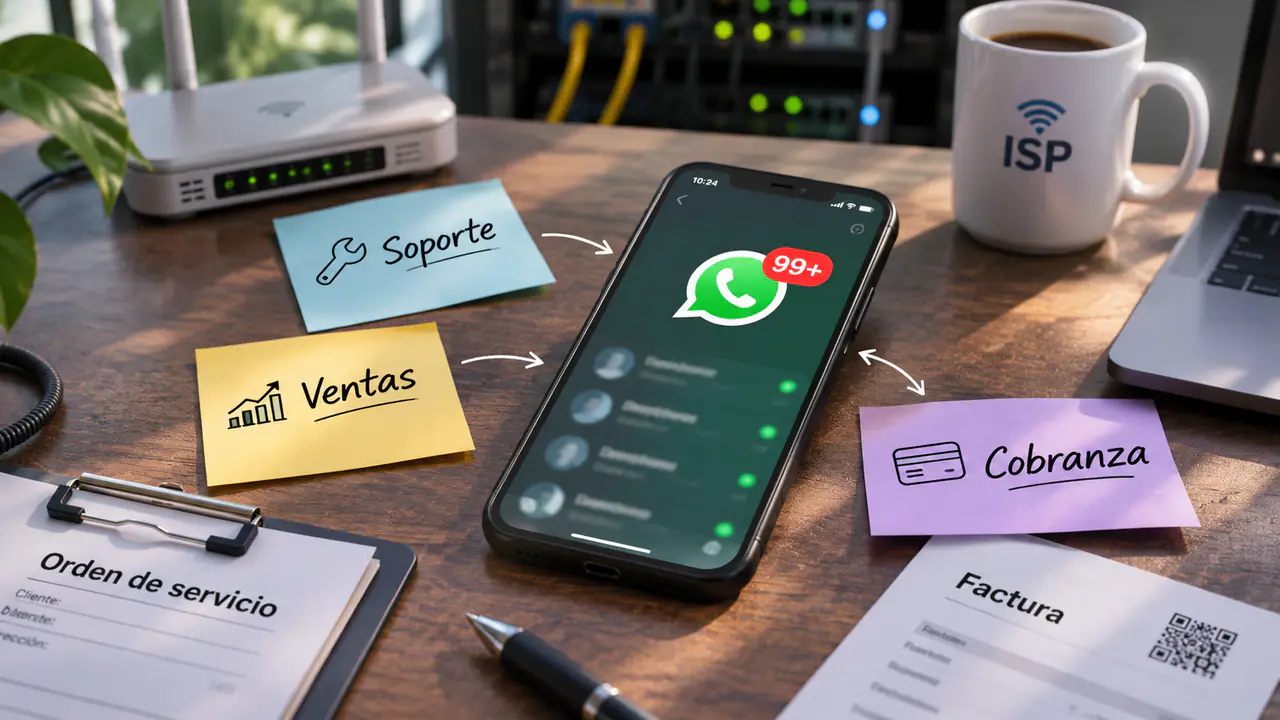
If you own an ISP, you probably live with a quiet fear: Meta blocking your main WhatsApp number during the first 5 days of the month.
Picture this: It's cutoff day. You have 500 customers writing in to send their payment receipts, another 50 asking for support because "the internet is slow", and you've just made the mistake of sending a mass "Bring a neighbor" marketing campaign from that same number.
Three people marked your message as spam. Meta's algorithm kicked in. Your main number is blocked. Nobody can report payments. Support collapses. Your personal phone starts ringing.
This scenario is more common than you think, and it comes from an architecture mistake: trying to do everything with a single number.
At Zelty AI we've analyzed millions of interactions at ISPs across Latin America and designed a "Communication Silos" architecture that shields your operation. You don't need one number; you need a Meta Portfolio Strategy.
This guide explains exactly how to structure your WhatsApp lines to automate your ISP with AI agents, separating "safe" traffic from "risky" traffic.
The Golden Rule: Inbound vs. Outbound Traffic
Before deciding how many lines you need, you have to understand how Meta (Facebook) thinks.
Inbound Traffic: The customer writes to you.
- Block risk: Almost none.
- Why: The customer has a need (their internet went down, they want to pay, they want to buy). They won't block you because they came to you. Meta loves this.
Outbound Traffic: You write to the customer (without them having messaged you in the last 24 hours).
- Block risk: High.
- Why: You're interrupting their day. If the message isn't relevant, if it's annoying, or if you send 1,000 messages and 10 people hit "Report spam", your line quality drops through the floor.
The fatal mistake ISPs make: mixing aggressive collections (outbound, risky) with technical support (inbound, safe) on the same channel. If you get blocked for collecting, you're left without support.
The 3-Line Architecture for ISPs (the Zelty Standard)
For an average ISP (1,000 to 20,000 subscribers), we recommend splitting the operation into three official WhatsApp API lines. Each one has a purpose, a tone of voice and a specialized AI agent behind it.
Line 1: The Support and Inbound Sales "Bunker" (the Sacred Line)
Purpose: Serve whoever comes to you. This line is sacred. It must never be used for mass spam. It's the number printed on your invoices, on your router and on your website's button.
Traffic type: 95% inbound (the customer starts).
AI agent in charge: Level 1 and 2 Support Agent and Sales Agent (receiver).
Functions:
- Technical support: ONU diagnostics, ticket creation in (Wispro/ISP Cube, others), mass outage detection.
- Billing: Receiving payment receipts (the customer sends the photo voluntarily), invoice downloads.
- Inbound sales: "Hi, I saw your ad, I want internet." The agent checks coverage and closes the sale.
Why this line is safe:
When a customer writes "I have no internet", they're desperate for an answer. The interaction is extremely valuable to them. The odds of them blocking this number are zero, because blocking it means losing their help channel. This is where your AI agent shines, solving problems in real time.
Line 2: The Growth Engine (Marketing Line)
Purpose: Hunt for opportunities. This is your "attack" line. It's used to reactivate databases, run retargeting and find new customers. If this line gets reported or temporarily blocked (which we mitigate with AI, but the risk exists), your support operation doesn't stop.
Traffic type: 80% outbound (you start with templates).
AI agent in charge: Proactive Sales Agent (Hunter).
The retargeting strategy:
Imagine that on Line 1 (Support) 50 people asked about coverage in the "Los Pinos" neighborhood, but 6 months ago you had no NAP box there. The AI agent saved those leads.
Today you roll out fiber in "Los Pinos". The AI agent takes that list and sends a mass campaign from Line 2:
"Hi [Name], a while ago you asked us about internet in Los Pinos. We're here now! We have a port reserved for you with free installation. Interested?"
Line 3: The Money Recoverer (Collections Line)
Purpose: Manage receivables. This is where money comes back into the till. It's the most delicate line and the one that needs the most artificial intelligence so you don't burn the customer.
Traffic type: 90% outbound (reminders and collections).
AI agent in charge: Collections and Payment Agreements Agent.
The problem today:
Many ISPs use SMS platforms or one-way messaging (like OnePay) to collect. They send: "Remember to pay your invoice."
The customer replies: "I already paid, here's the photo" or "I can't pay today, can you wait until Friday?". Nobody answers. The system is blind. The customer gets frustrated and collections fail.
The Two-Way AI Solution on Line 3:
This line sends the reminders, but it's alive. There's an AI agent behind it waiting for the reply.
Hi [Customer], your invoice is due tomorrow. Here's the Nequi/Mercado Pago QR code to pay easily.
Thanks, I'll do it now.
Low block risk: it's a useful reminder.Hi [Customer], your service is suspended. You have a balance of $X. Avoid a negative credit report by paying today.
Honestly, I can't pay you right now, something came up
I completely understand, and I'm sorry you're going through a hard time. Please let me know if you can make a partial or full payment of the balance...
Why keep this line separate: Collections create friction. A customer in arrears who gets a "Pay or we cut you off" message is the most likely to mark it as spam out of anger. If you use your main line (Line 1) to collect aggressively and it gets blocked, customers who are up to date (the good ones) won't be able to ask for technical support. Never mix heavy collections with support.
Behind the Scenes: How AI Unifies the Chaos
You might think: "Having 3 numbers is a mess for me."
That's where Zelty and Chatwoot come in.
Even though the customer sees 3 different numbers (Support, Promotions, Collections), you and your team see one unified inbox.
Centralization:
Conversations from Lines 1, 2 and 3 land in the same software.
Shared context:
If the Collections AI agent (Line 3) reaches a payment agreement, it updates the CRM (Wispro/ISP Cube). If that same customer writes to Line 1 (Support) 10 minutes later saying "I have no internet", the Support AI agent already knows they just paid and says: "I see you just settled your payment; your service is restarting, give it 5 minutes."
Human escalation:
If the AI can't solve something on the Collections Line, it transfers the conversation to the "Billing Support" team. Your employee replies from their computer no matter which number the customer wrote to.
Critical Data: Meta's Block Thresholds
To run your Marketing and Collections lines, you need to know Meta's (WhatsApp API) rules of the game. It's not about "if they block you" but "when they lower your quality".
Meta rates your numbers in three quality states:
Green (high quality): All good.
Yellow (medium quality): Warning. You've received several recent spam reports.
Red (low quality): Critical danger. Meta will pause your outbound campaigns.
The "Tier" (Messaging Limit):
Every number starts at a level.
- Tier 1: you can message 1,000 unique users every 24 hours.
- Tier 2: 10,000 users every 24 hours.
- Tier 3: 100,000 users every 24 hours.
- Tier 4: unlimited.
How do you move up? By sending twice your current limit within 7 days without your quality dropping.
How do you get moved down? If your quality turns Red, Meta lowers your tier (e.g., from 10k to 1k messages a day).
Zelty's Strategy to Avoid Red:
"Opt-Out" detection:
If a customer on Line 2 (Marketing) replies "Not interested", the AI automatically tags them as "Do not disturb" and removes them from future lists. That keeps them from reporting you as spam next time.
Line warm-up:
When we launch your Collections Line, we don't send 5,000 messages on day one. The AI agent paces the sends: Day 1 (500 messages), Day 2 (1,000), Day 3 (2,000). This "teaches" Meta that your traffic is legitimate.
Action Plan Summary
If you're going to automate your ISP with Zelty AI, this is the structure we'll set up:
Number A (existing): Becomes support and inbound sales only.
Action: Migrate it to the WhatsApp API. Connect the Zelty "Technical, Billing and Sales" agents.
Number B (new): Bought for marketing campaigns.
Action: Connect the Zelty "Hunter" agent.
Number C (new): Bought for collections.
Action: Connect the Zelty "Collections" agent. Integrate with Wispro/CRM so the AI knows who owes and how much.
Share this article